We have studied the implementation of Backward Stream Reasoning approach, which provides a way to realise backward reasoning on needed tuples in order to answer continuous queries. In this way, our DubExtensions extension is able to provide more expressive queries able to completely exploit the advantage of working on structured information (Streaming Linked Data). By exploiting these data we have provided a backward stream reasoning module, to materialise all necessary tuples in order to answer complex queries. For this reason, we have studied the dependencies between the RDFS rules, reducing the number of rules that could trigger other rules with their conclusions, and optimising the reasoning approach by exploiting techniques of backward chaining.
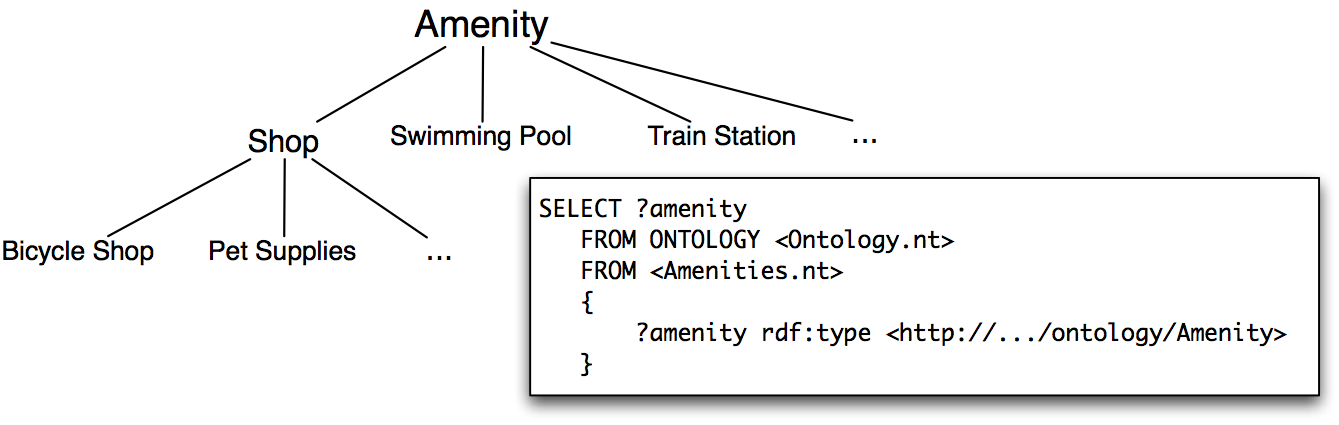
We have exploited Lehigh University Benchmark (LUBM), used to evaluate queries over a large static dataset, by executing with a single realistic ontology, and designed to work in the specific university domain.
Since LUMB works in the university domain, we consider static information all data that refer to universities, professors, researchers, departments, and courses, while everything that concerns data of students have been considered as a stream.
In the test below we keep fixed the total number of triples and we vary the window size to understand which relationship links the number of triples into the window and the throughput value of a query.
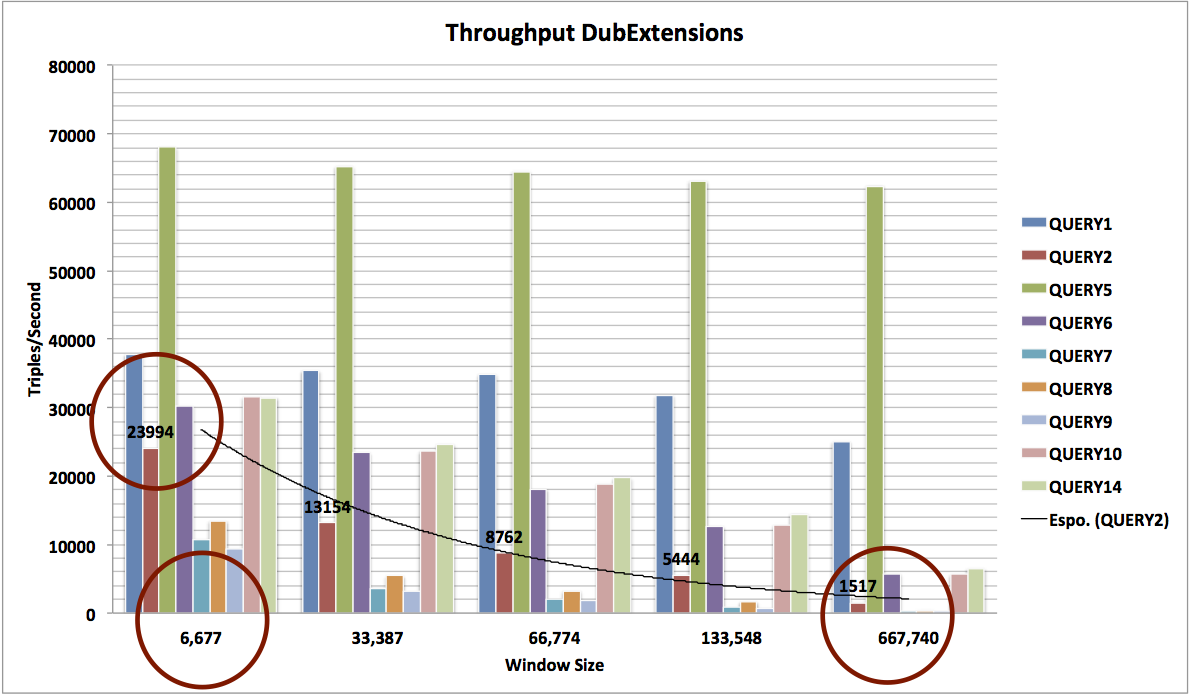
The graph shows that by reducing the size of the window the general throughput values of every query increase. On the other hand, by increasing the window sizes the general throughput values of the queries decrease. That the relationship between different throughput values and different window sizes is linear, as is the graph of the above figure. To give a numerical case, we can consider query 2, which presents the same standard trend of all other queries. Thus, to the corresponding window size of 6677 triples, the initial throughput is 23994triples/second, and corresponding to the window size of 667740 triples the throughput decrease to 1517triples/second. This means that, increasing the window size of 100 times there is a reduction of the throughput value of 15 times, therefore the two concepts are relate in the rate 15/100.